HIC Delegation Engagement at ICARRD+20
The International Conference on Agrarian Reform and Rural Development +20 (ICARRD+20), held in Cartagena, Colombia in February 2026, marked the 20th anniversary of the landmark 2006 conference on agrarian reform. This event brought together governments, academics, international organizations, and civil society movements to evaluate progress toward more-equitable land governance and rural development. The Habitat International Coalition (HIC) delegation participated actively, presenting civil society perspectives and advocating for stronger alignment with human rights, land justice, agroecology, and sustainable and continuously improving rural livelihoods.
Background: The Importance of Agrarian Reform
Land governance has emerged as a central global challenge due to increasing pressures from climate change, biodiversity conservation efforts, industrial agriculture, urbanization, infrastructure development, and expanding agricultural markets. Without secure land tenure and equitable access to natural resources, these pressures can exacerbate land conflicts, displacement, and rural inequality. ICARRD+20 was convened by Colombia, with support from Brazil, to reassess and update commitments made in 2006 and to remedy contemporary derogation of land rights, particularly those affecting small-scale farmers, Indigenous Peoples, rural women, fishers and pastoral communities.
Civil society organizations emphasized that unequal control over land, forests, water, and fisheries remains a major driver of poverty, hunger, and environmental degradation. Concentration of land ownership, corporate expansion, and financialization of natural resources threaten environmental sustainability, the livelihoods of rural populations and undermine human rights.
Role of the Habitat International Coalition Delegation
The HIC–HLRN delegation participated in the preparatory academic conference, peoples’ and social movements’ forum, and the official conference and parallel events. Their involvement aimed to ensure that the voices of grassroots organizations and affected communities, including the urban food-insecure constituency, were represented in the global debate on agrarian reform.
The delegation’s advocacy emphasized the related human rights norms as developed since 2006 as obligations and the grounding of negotiations with states. HIC delegates also promoted the convergence of rural, urban and Indigenous social movements as needed to cooperate in needed policy reform across sectors. HIC interventions also drew on the UN Remedy and Reparations Framework (RRF) —also adopted by acclamation exactly 20 years ago—as a minimal standard for restorative agrarian reform with justice for Indigenous and rural communities.
At ICARRD+20, HIC–HLRN stressed the need for policies that protect communities from forced evictions, land dispossession, and environmental harm. The delegation also emphasized the importance of integrating human rights standards into land governance frameworks, ensuring that agrarian reform supports social justice, climate-change mitigation through agroecology and sustainable development.
Key Issues Raised by Civil Society
Several critical issues dominated the discussions in which the HIC delegation participated.
1. Inequality in Land Rights
A major concern raised at the conference was the growing concentration of land in the hands of large corporations and financial investors. This current trend of unprecedented land concentration embattles smallholder agriculture, food sovereignty, and rural livelihoods. Civil society representatives argued that redistributive agrarian reform remains essential to combatting poverty, mitigating climate change and ensuring equitable development.
2. Rights of Indigenous Peoples and Rural Communities
Indigenous and traditional communities often rely on collective land tenure systems and customary governance structures. These systems are frequently overlooked or undermined by national land policies and development projects. Participants stressed the need for legal recognition and protection of these collective rights, as well as respect for traditional knowledge and land stewardship practices. HIC, International Indian Treaty Council and other Food Sovereignty International Planning Committee (IPC) members vigorously opposed the pernicious conflation of Indigenous Peoples with the indistinct classification of “local communities,” which some state delegations (e.g., India and Indonesia) promote to derogate the rights of Indigenous Peoples they occupy.
3. Gender Justice in Land Governance
HIC joined other civil society organizations calling for stronger legal protections for rural women’s land-tenure rights and greater participation of women in decision-making processes related to land governance and rural development.
4. Environmental and Climate Dimensions
HIC participation also highlighted the intersection between land rights and environmental sustainability. Secure land tenure of small-scale producers and Indigenous Peoples is critical for effective climate action, biodiversity conservation, and sustainable land management. When such communities have recognized and protected rights over their territories, they are more able to protect ecosystems and implement sustainable practices, including through agroecological practices.
Recommendations and Outcomes
The HIC–HLRN delegation aligned with other members and constituencies convened by the IPC promoted a vision of “global, integrated agrarian reform,” which links land redistribution, environmental stewardship, and human rights. Their recommendations included:
- Strengthening legal protections for land tenure and habitat-related human rights.
- Recognizing and supporting collective land rights of Indigenous Peoples and rural communities.
- Ensuring meaningful participation of civil society and social movements in policymaking.
- Addressing land inequality through redistributive policies and land restitution programs.
- Integrating agrarian reform with climate, biodiversity, and food systems policies.
Civil society groups also emphasized the need for accountability mechanisms to monitor the implementation of conference commitments and ensure that states uphold their obligations under international human rights law.
Looking Ahead
ICARRD+20 represents an important opportunity to reinvigorate global commitments to agrarian reform and responsible land governance. However, the success of the conference will depend on translating its discussions into concrete policy changes and practical measures at national and local levels.
For organizations such as HIC and its Housing and Land Rights Network (HLRN), continued advocacy in collaboration with Indigenous and grassroots rural and urban social movements remains essential to influence land governance reforms that prioritize human rights, social justice, and ecological sustainability. By amplifying their voices and defending rights to land and habitat (i.e., equitable and sustainable access to, use of, and control over land and natural resources), civil society can play a crucial role in shaping a more equitable and sustainable future for rural populations worldwide.
See complete report on HIC engagement at ICARRD+20 here
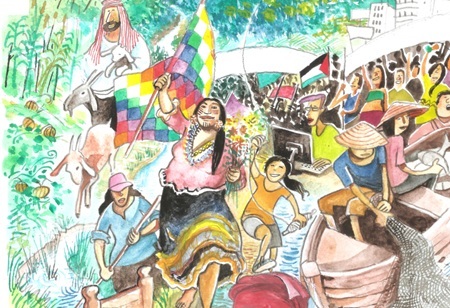
Image: Artwork on the banner at the Forum of Movements and Peoples for Land, Water, Territory, and Dignity. Source: HLRN.
|