Green Evictions
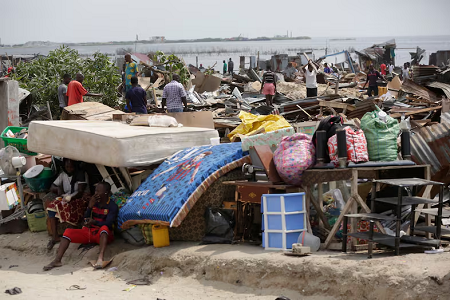
Informal settlement communities are increasingly displaced in the name of environmental protection, climate adaptation, and disaster risk reduction. From flood mitigation projects in Latin America to conservation zones in Africa and coastal resilience programs in Asia, environmental concerns are weaponized to justify evictions that violate human rights and perpetuate urban inequality.
While genuine environmental risks demand action, the dominant response—forced evictions without adequate resettlement or community participation—transforms environmental governance into a tool of displacement. Meanwhile, the Global Goal on Adaptation indicators adopted at CoP30 pose a further risk of incentivizing relocations that disregard and, ultimately, violate individual and collective rights, which arise from common human needs.
“Green evictions” were the subject of a side event organized by MISEREOR in the Habitat Village at WUF13. On the session’s panel, HLRN coordinator Joseph Schechla responded to the following question:
In recent years, HLRN has enhanced its Violation Database (VDB) to include displacements related to environmental protection and climate adaptation. What prompted HLRN to do so, and how can member organisations and the public use this data in their work with affected communities and/or in policy processes?
In response, HLRN’s experience with the VDB, a growing number of documented cases involve governments, development banks, conservation organizations, or local authorities justifying human-settlement removals in the name of “climate adaptation,” “disaster risk reduction,” “resilience,” or “managed retreat.” Meanwhile, affected communities argue that the processes have been coercive, inadequately consulted, or amounted to “forced eviction.”
Informing communities and policy actors are some of the most important cases in the past 20 years involving forced evictions of inhabitants on the pretext of environmental project. What motivated HLRN to shift its methodology were the patterns that emerged to demonstrate structural incoherence across continents. They revealed how:
- Land becomes economically or strategically valuable.
- Environmental language sometimes then extraction/control as “protection,” “green transition,” “conservation,” or “environmental development.”
- Indigenous, rural, poor, and/or otherwise politically weak populations are removed, incurring costs, losses and damage that warrant remedy.
- Human needs and corresponding rights are suspended in the name of planetary necessity.
HLRN has observed that environmental protection is structurally coherent only if it preserves both ecosystems and the various rights of inhabitants in sustainable balance. However, a “green” project requiring coercive displacement reproduces the same domination logic as extractive colonialism. These reflect different branding but retain the same structure and outcomes. Some of the major illustrative cases recorded in the VDB are detailed in the VDB, including:
1. Maasai Evictions — Tanzania;
2. Sengwer Evictions — Kenya;
3. Adivasi Eviction for Tiger Reserves — India;
4. Batwa Evictions — (Uganda, Rwanda, Democratic Republic of the Congo);
5. REDD+ Carbon-offset Evictions — United Nations/Multiple Countries such as
Batéké Plateaux (DRC), Southern Cardamom (Cambodia), and Antsotso (Madagascar);
6. Ogiek Evictions — Kenya;
7. Indigenous Evictions for “Green Energy” Mining — Latin America & Africa (Chile, Serbia,Democratic Republic of the Congo);
8. Benet Evictions — Uganda;
9. Coastal “Climate Adaptation” Evictions — South and Southeast Asia (Bangladesh, Indonesia, Nigeria, Philippines);
10. “Sunbelt Apartheid” — Arizona, USA;
11. Petrópolis Landslide — Brazil.
Structural Pattern across All Cases
The central issue is not environmental protection. Ecological collapse is real and actualized through greenhouse gases emitted by urbanization, industrialization and the accumulation of waste, especially in the Global North. The contradiction emerges when ecosystems are treated as valuable for their exchange value, but vulnerable inhabitants are treated as disposable. The contradiction is aggravated when vulnerable communities ultimately pay the price for the avarice of wealthier and more powerful decision makers.
That reveals the actual priority hierarchy in policy, whereas governments face a choice between development and gross human rights violations involving forced eviction. In such cases, they similarly face a dilemma/trade-off between environmental protection and state crime, prioritizing the latter.
A coherent environmental model would require:
- Free, prior and informed consent of the parties subjected to projects,
- Indigenous sovereignty over land and natural resources,
- Official recognition of primacy of legitimate tenure rights along the spectrum/continuum of land rights,
- Non-coercive participation,
- Respect for the authority of local stewardship,
- Ecological protection without dispossession,
- Accountability for industrial and urbanization actors driving destruction.
Without those conditions, “green” governance becomes a moral shield for territorial consolidation at the affected Indigenous People’s or local community’s expense.
The recurring structure is not conservation versus people. It is centralized power versus populations with insufficient power and other resources to resist removal.
With its dual preventive and remedial function, the set of minimum human rights criteria for a lawful eviction—by any other euphemism—has remained in force for three decades to guide a coherent habitat policy. Implementing those safeguards may avoid turning climate change-affected cities into urban conflict zones, as also in their peripheries.
For compete analysis (in English), see Green Eviction in the VDB
Photo: Residents salvage objects from houses demolished by government officials in Otodo-Gbame waterfront in Lagos, Nigeria, on Saturday, 18 March 2017. Source:
Sunday Alamba/AP.
|