Azerbaijan
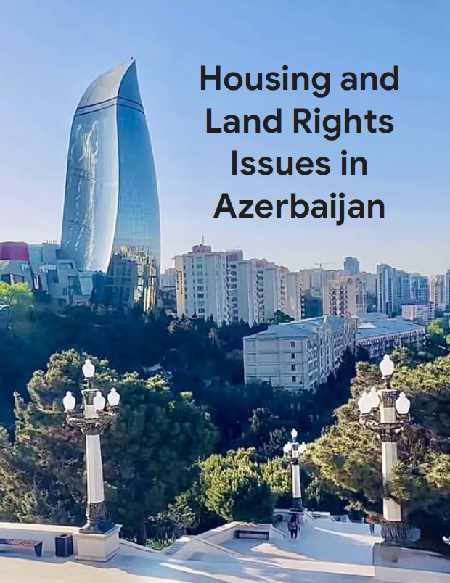
On the occasion of the 13th World Urban Forum (WUF13), 17–22 September 2026, HIC-HLRN has prepared this new report to summarize the main housing and land rights issues since 2000 in Azerbaijan, the WUF13 host country. Housing and Land Rights Issues in Azerbaijan reviews events and developments, exploring the discrepancies between administrative practice and relevant law, including Azerbaijan’s Constitution, legislation and Human Rights Treaty obligations with a focus on the human right to adequate housing.
During the review period, the systemic displacement of marginalized populations in Azerbaijan represents a critical intersection of the country’s post-Soviet economic transition, modern urban expansion, and aggressive implementation of state-led spatial and social engineering.
Since 2008, the government of Azerbaijan has been implementing a program of forced evictions in the capital city of Baku, confiscating and subsequently demolishing privately owned properties to make room for the development of modernized infrastructure. The evictions were first ordered by the city`s municipal government as part of a massive reconstruction effort aimed at increasing the appeal of the downtown metropolis. From 2011 onward, the number of housing complexes being forcibly vacated has increased substantially.
Numerous development projects have begun in the aftermath of the housing demolitions, including new parking lots, several boutique stores, boulevards, skyscrapers, a shopping center, luxury housing, and a Formula One race track. There are also plans to build a 1,050 m (3,444 ft) housing complex, which would make it the world`s tallest man-made structure upon completion.
Baku city officials have stated that the compensation being offered to residents is fair, while human rights groups argue that residents have been pressured to leave without adequate compensation to buy similar dwellings elsewhere. Independent observers estimate that several thousand people have been displaced as a result of the forced evictions.
Historically, ethnic Armenians and Azerbaijanis have been subjected to “mutual ethnic cleansing,” not least in the context of ware between Armenia and Azerbaijan in 1988–94. Between 2000 and 2026, the trajectory of forced evictions in Azerbaijan transitioned from the immediate displacement of the urban poor for city beautification to a coordinated, mass-scale campaign of conflict-induced ethnic expulsion (legally defined as the serious crime of population transfer) and infrastructure-induced demolitions targeting both the capital city of Baku and rural regions slated for extractive industries.
The period is marked also by urban infrastructure projects characterized by aggressive forced evictions and home demolitions without proper reparations and the population transfer and dispossession of over 100,000 indigenous Armenians from Nagorno-Karabagh. This report also annexes the violations documented in the HLRN Violation Database (VDB) during the period.
Download Housing and Land Rights Issues in Azerbaijan(HLRN, 2026)
Image: Cover of Housing and Land Rights Issues in Azerbaijan. Source: HLRN.
|