Land Grabbing and the Prolonged Conflict in Sudan
For decades, Sudan has been subjected to successive conflicts and political instability amid internal and extraterritorial competition over its natural resources, particularly though coercive land seizures. Since the outbreak of the latest civil war in 2023 between the Sudanese Army and the Rapid Support Forces (RSF) backed by the United Arab Emirates (UAE) government, the conflict has caused the largest and most-severe displacement and protection crisis in the world, leaving 11.58 million internally displaced persons (IDPs), as previously reported in Land Times/أحوال الأرض. The number of people forced to leave their homes in a single year of this war is double the number Sudan witnessed during the previous two decades combined. Sudan now accounts for 15% of the world’s total IDPs.
Structural and Conflict-driven Land-governance Hazards
With the lack of effective protective measures for communities and small farmers, the collapse of the state and its legal infrastructure for land ownership rights after 2023, foreign control and expansion have intensified, leading to the Sudanese agricultural system being tied to external demand rather than local needs. Investments by Gulf states and land purchases in Sudan have shifted from a “developmental” framework to a fundamental pillar of the war economy.
As the war devastated the agricultural sector, entire farming regions were depopulated, markets collapsed, and grain production in 2023–2024 fell to close to catastrophic levels. Furthermore, militia control of trade routes, coupled with fuel shortages, rising prices, displacement, and obstructed humanitarian access, prevented food from reaching local communities or displacement camps. Most importantly, large-scale export agriculture, systematically controlled by foreign entities, has replaced the smallholder farming that was the backbone of Sudan’s food supply.
Meanwhile, since April 2023, Sudan’s cultivated land has shrunk from roughly 18 million ha. to just 7 million ha. nationwide, as farmers have been displaced and infrastructure destroyed. An estimated 60% of the agricultural area used before the war has gone out of production due to the conflict.
Extraterritorial Factors
Sudan poses an attractive and proximate object for Gulf countries—particularly Saudi Arabia and the UAE—to acquire fertile land for export agriculture. These powerful states are building an external food-security system with abundant water resources, long-term leases, tax exemptions, and access to irrigation networks, particularly with the passage of the National Investment (Encouragement) Act in 2013 (repealed in 2021). The area of land seized under the Act has reached 762,208 ha., and investors from countries in the region are competing for another 3.4 million ha. of land, which remains under negotiation.
Although the UAE’s primary extractive interests in Sudan are gold and food. Over the past fifteen years, the UAE has striven to gain control over agricultural land and water resources in Sudan to produce food for export. UAE has invested more than US$6 billion in Sudan’s foreign exchange reserves, agricultural expansion projects, and the construction of a port on the Red Sea.
In the midst of the war, two Emirati companies were cultivating more than 50,000 ha. of Sudan’s land. Shortly before the war broke out, the Abu Dhabi-based International Holding Company (IHC) signed a US$225 million deal with Sudan’s Osama Daoud Abdellatif, chairman of DAL Group, to develop an additional 162,000 ha. of agricultural land in Abu Hamad, in the north of the country. This massive agricultural project, backed by the UAE government, will be linked by a 500-kilometer road to a new port on the Sudanese coast, to be built and operated by the Abu Dhabi Ports Group.
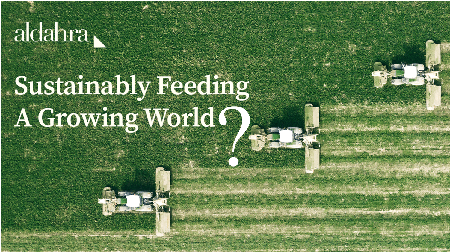
Land grabs for agricultural purposes have intensified across Sudan during the war. In al-Hawad Valley, a fertile region spanning from Sahl al-Batana in eastern Sudan, al-Dahra Holding, a prominent UAE-based agribusiness, has acquired 27,000 hectares (approximately 64,000 feddans) of land. This is part of a long-term al-Dahra US$10 billion investment plan to acquire 2.4 million acres (971,245.5 ha.) there. Since the April 2023 war outbreak, large-scale mechanized farming has been expanding northward into marginal areas, such as the Butana grasslands, where environmental risks are high.
Land grabs in Sudan have not been limited to agricultural and commercial investments; they have become a tool for displacement and deprivation. While gold is smuggled to the UAE and livestock is exported to Saudi Arabia, the vast tracts of land used for these two sectors are prioritized at the expense of subsistence farming and efforts to combat famine in Sudan. These enterprises have displaced approximately 70% of smallholder farmers surrounding the country’s largest irrigation project, the al-Jazira Project. Various Gulf states have acquired 1.9 million acres, many of which do not produce any crops; only 4.2% of large-scale investments produce food, while local residents are barred from using the land.
International Dimensions
These are mere glimpses into the dire situation in Sudan. However, they serve as examples of how extraterritorial agricultural investments, presented under the banner of “food security,” or even “green transformation” coincide with dispossession and “starvation of historical proportions.”
Both the UAE and Saudi Arabia have boasted robust policies aligned with the international climate agenda, while “carbon laundering” through their investments in the new scramble for Africa’s land. Examples include cases in Kenya and Liberia, prompting calls for a moratorium on carbon-offset projects.
In developing a strategy to address these grand-scale violations, since 2016, the International Criminal Court has explicitly stated that it will prioritize crimes involving the illegal exploitation of natural resources and the illegal seizure of land as potential “crimes against humanity.” The court has conducted an investigation into war crimes and crimes against humanity in Darfur, which include population transfer, including composite acts of forced displacement, that are often linked to land confiscation and, when externally driven, colonialism.
The pattern of land concentration in the context of war elsewhere, as noted in HIC-HLRN’s most recent input to CESCR’s forthcoming General Comment on the Covenant rights in cases of conflict, emphasizing the contemporary cases of occupied and colonized Palestine and Western Sahara. International jurisprudence has found intense concentration of land ownership (i.e., land concentration) as both a cause and consequence of conflict, occupation, war and structural violence. The courts have affirmed states’ duty to search for the missing, protect property, and address root causes of conflict such as land inequality and forced displacement.
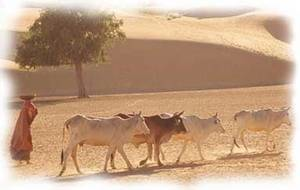
Photo: Promotional material from al-Dahra Holding [question mark added]. Source: al-Dahra Holding website.
|