Lessons of Urban Warfare
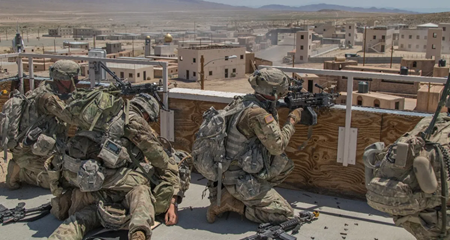
Since the Second World War, the countries of southwest Asia and North Africa have been battlegrounds in the sphere of U.S. and European hegemony over the territory of the former Ottoman Empire. Whether under occupation and colonization as in Palestine and Western Sahara, or through invasions and arming proxy militias to destabilize the region into a state of perpetual crisis, this period has also provided a testing ground for Western tech firms and arms merchants to develop tactics and weapons that include significant developments in urban warfare.
At least three major lessons have emerged, especially evident in the Battle of Aleppo, Battle of Mosul, and Israel’s ongoing Gaza genocide operations. These battles have forced militaries to rethink assumptions about technology, control of cities, and how urban wars actually unfold. The lessons shaping future war planning are now structural rather than situational.
1. Intelligence Dominance Matters More Than Firepower
In dense cities, seeing the battlefield is more decisive than possessing the most weapons. In Mosul, the U.S.-led Coalition forces had overwhelming firepower and air superiority, yet progress slowed dramatically in neighborhoods where fighters from Islamic State:
- hid within civilian populations
- used tunnels and concealed firing positions
- constantly moved among buildings.
Without precise intelligence, large amounts of firepower produced destruction, but not control.
In Aleppo, surveillance—especially drones and signals intelligence—became critical for identifying:
- sniper nests
- weapons depots
- command locations.
In Gaza, dense urban infrastructure and underground networks meant that forces cannot rely on traditional battlefield visibility. The resulting doctrine now operates such that modern militaries now emphasize:
- persistent surveillance
- real-time intelligence sharing
- AI-assisted target identification
- integration of drones with infantry units.
Urban combat planning increasingly treats information and technical dominance as the primary battlefield objective.
2. Cities Function as Layered Battlefields
Urban war is no longer two-dimensional. Cities operate as multi-layer combat environments. All three of these emblematic conflicts have shown simultaneous fighting across multiple vertical layers:
Underground
- tunnel systems
- hidden supply routes
- command bunkers.
At street level
- barricades
- Traps with IEDs (improvised explosive devices)
- ambush positions.
Using buildings as
- sniper nests
- fortified apartments
- shields for movement between and among structures.
Airspace
- drones conducting reconnaissance and attacks.
In Mosul, tunnel networks allowed defenders to appear behind advancing forces. In Aleppo, fighters moved between buildings and underground passages to evade detection. In Gaza, subterranean networks fundamentally altered how forces must operate.
The resulting doctrine is that militaries are constantly developing new capabilities, using:
- subterranean warfare units
- 3-D mapping of cities
- robotic reconnaissance systems
- urban sensors and mapping technologies
Urban war planning increasingly treats cities as vertical combat systems rather than horizontal terrain.
3. Tactical Victory Does Not Equal Urban Control
The region’s urban warfare has established the principle that capturing territory in a city does not mean actually controlling the city. The major battles have revealed that:
In Mosul, the city was declared liberated, yet reconstruction, governance, and security challenges persisted for years.
In Aleppo, the military battle ended, but the destruction of infrastructure and displacement of populations created long-term instability.
3. Social impacts
Urban warfare now produces:
- mass displacement
- infrastructure collapse
- governance vacuums.
Since control of buildings does not equal control of people, services, or political order, military planners increasingly integrate:
- stabilization operations
- civil administration planning
- infrastructure restoration
- humanitarian coordination.
Urban warfare planning now includes post-battle governance strategies, because without them instability returns. Such scenarios result in conditions defined as “occupation” in international law. That is a point at which a military operation (e.g., invasion) assumes local administration.
Where Urban Warfare Is Heading
The combined lessons point toward a future urban battlefield defined by:
Persistent surveillance: Continuous monitoring through drones, sensors, and AI analysis.
Subterranean combat: Dedicated doctrine for fighting beneath cities.
Distributed small-unit warfare: Small autonomous teams rather than large formations.
Civilian-density constraints: Urban wars occur among millions of civilians, creating logistical limits and the potential for individual criminal liability.
Infrastructure as strategic terrain: Power grids, water systems, hospitals, and communications networks become critical operational targets.
These examples lead to a core conclusion that urban warfare is evolving toward information-driven, multi-layer combat inside megacities, where controlling data, underground space, and civilian systems matters more than simply capturing ground.
Many military strategists now believe future major wars will be decided in megacities of 10–30 million people, which constitutes a shift that is radically changing global defense planning. This development tests the relevance of the Fourth Geneva Convention relative to the Protection of Civilians in Time of War. That 1949 Convention underwent further development in 1977 to modernize the rule of war by (1) establishing the principle of distinction; (2) protecting means of survival (civilian lifelines, such as drinking water installations, crops, and food); (3) restricting high-risk targets like dams, dikes, and nuclear power stations; (4) limiting certain weapons; and (5) addressing the emerging phenomenon of non-state actors in military operations and civil wars.
The specific lessons of urban warfare in the Middle East and North Africa may give rise to new thinking for future Protocols to address additional subjects and fill legal gaps. These likely would cover domicide, lethal autonomous weapons, cyberwarfare, the “black box” problem, whereby, especially when using autonomous weapons, military commanders are legally required to perform a proportionality assessment (weighing civilian harm vs. military advantage) before striking.
Of all the lessons from regional wars, none has yet to result in remedy and reparations for civilian victims, while those awaiting their corresponding entitlements now total over 54 million.
Photo: Soldiers during war games in an Israeli urban-warfare training facility. Source: Capt. Gregory Walsh, U.S. Army.
|